Intentional Teaming
A Systems Perspective on Designing High-Performing Teams
Abstract
Organisations routinely invest significant effort in selecting team members, defining objectives, establishing reporting structures and adopting recognised management frameworks. Yet the collaborative and governance systems through which teams perform their work are often inherited, standardised or introduced without sufficient regard for the people, tasks and conditions involved. This paper proposes Intentional Teaming as a systems-oriented approach to the deliberate and continuing design of how a particular team collaborates, governs, coordinates, decides and learns. Intentional Teaming begins with the team that actually exists. It considers the members' capabilities, relationships, cultural contexts and working needs alongside the purpose, interdependencies, uncertainty, risk and technological environment of the work. It then treats frameworks, methods and governance arrangements as configurable design resources rather than universal templates. The paper draws on sociotechnical systems theory, team-effectiveness research, organisation design, person–environment fit, psychological safety and collaborative-organisation scholarship. It also incorporates practitioner reflection concerning situations in which capable teams struggled to deliver because their operating systems appeared poorly aligned with their members and work. The paper proposes an initial Intentional Teaming Design Architecture comprising eight interconnected domains: people, purpose, context, work, collaboration, governance, enablement, and learning and adaptation. This architecture is presented as a conceptual synthesis rather than a validated theory. The paper argues that high-performing teams are not created simply by assembling talented individuals or implementing established frameworks. Their performance is shaped by whether the systems surrounding those individuals enable coordinated, contextually appropriate collective action.
1. Introduction: Teams formed intentionally, operated accidentally
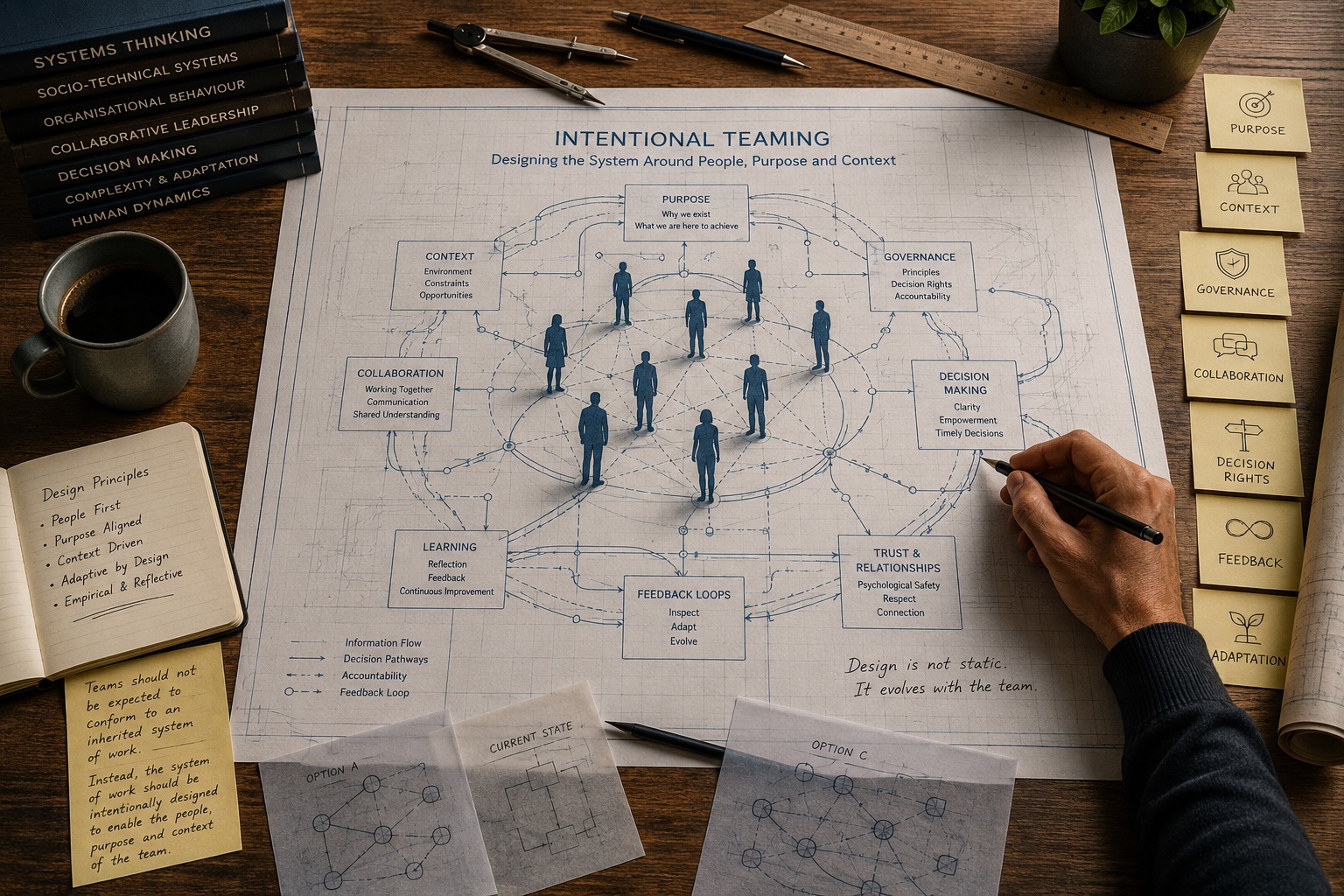
Organisations seldom create teams entirely by accident. People are recruited or reassigned, roles are approved, objectives are established, budgets are allocated and reporting relationships are defined. In technology-driven organisations, considerable attention may also be given to product architecture, delivery methods, work-management systems, technical standards and organisational structures. However, the design of how a team will operate as a collective is often less deliberate. Teams inherit meeting cadences, role definitions, decision rules, escalation pathways, reporting obligations and communication practices from the organisations around them. They may be expected to adopt Scrum, SAFe, Lean, matrix structures, project governance, self-management or other recognised models. These approaches can provide useful language, discipline and accumulated practice. The problem arises when the framework is selected before the team and its context have been adequately understood. In such cases, the framework becomes the starting assumption. The people are expected to conform to its roles, rituals and behavioural expectations. When the arrangement fails to produce the expected results, the organisation may conclude that the team has not implemented the framework correctly, lacks discipline, resists change or requires further coaching. Less attention may be given to another possibility: the collaborative system may be poorly fitted to the people and work. This paper advances a different starting proposition: teams should not be expected to conform unquestioningly to an inherited system of work. The system of work should be intentionally designed to enable the people, purpose and context of the team. This does not imply that individuals should never adapt, develop new capabilities or meet shared behavioural standards. Nor does it imply that every team should invent an entirely unique way of working. It proposes that frameworks, governance arrangements and collaborative practices should be treated as design resources whose suitability must be examined rather than as universally applicable solutions. The concept developed in this paper is called Intentional Teaming. Intentional Teaming refers to the deliberate and continuing design of the collaborative, governance and coordination system through which a particular group of people performs its work. It begins with the team's actual members, purpose and context and configures ways of working around those conditions rather than requiring the team to conform automatically to a predetermined framework. This concept is compatible with established research showing that teams are embedded in broader organisational systems and that their effectiveness is influenced by task design, composition, context, coordination, communication, leadership and developmental processes (Kozlowski & Ilgen, 2006; Mathieu et al., 2008). Intentional Teaming does not replace that research. It seeks to synthesise it into a practical design orientation.
2. Practice Context and Researcher Positioning
My interest in Intentional Teaming emerged from repeated experience across technology, delivery, transformation and organisational-change environments. I have worked with teams containing capable, committed and experienced people who nevertheless struggled to achieve the outcomes expected of them. In some cases, the difficulty was explained as a capability problem, a leadership problem, inadequate accountability, poor communication or insufficient adherence to a chosen delivery framework. These explanations were sometimes valid. Teams can lack skills, avoid difficult conversations or fail to perform agreed responsibilities. Over time, however, I began to notice a broader pattern. The difficulties were not always located primarily within the individuals. In some situations, the people were attempting to operate inside systems that worked against their ability to contribute. Authority might be concentrated away from the expertise required to make a decision. Teams might be described as autonomous while remaining dependent on multiple approval layers. Roles might be defined by a framework but remain disconnected from the organisation's actual accountabilities. Meetings might be added to resolve information gaps produced by the wider system. Consensus might be expected for decisions that did not require collective ownership, while consequential decisions affecting several disciplines might be made unilaterally. The resulting friction was frequently interpreted as a problem with the people. This eventually led me to reverse the usual question. Rather than asking only why teams were failing to implement the framework, I began asking whether the framework and surrounding governance arrangements had been appropriately designed for the team, task and context. My position in relation to these systems requires explicit acknowledgement. I have not been an external or neutral observer. My professional roles have included leadership, delivery management, organisational coaching and the introduction or reinforcement of methods intended to improve team performance. At times, I have participated in creating the same forms of standardisation that I later came to question. I may have interpreted discomfort as resistance, promoted consistency before sufficiently understanding local work, or assumed that a recognised practice would transfer effectively between settings. Intentional Teaming therefore emerges partly from critical reflection on my own practice. These observations do not provide generalisable proof. They are practitioner reflections that shaped the question being investigated. Personal experience can reveal recurring tensions and generate useful inquiry, but it is vulnerable to retrospective interpretation, selective memory and attribution bias. The conceptual argument must therefore be examined in relation to established research and, eventually, empirical evaluation.
3. The limits of framework-first team design
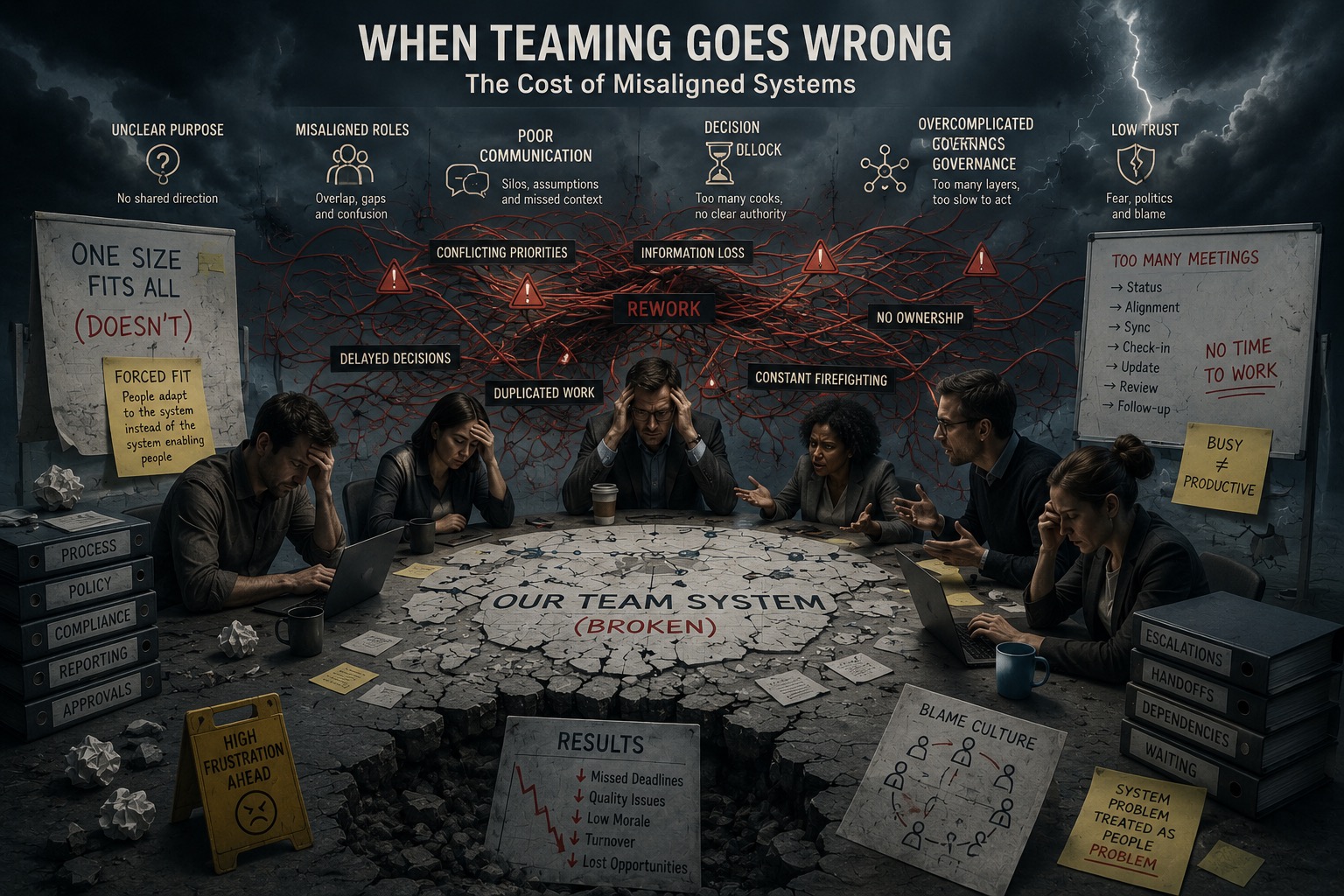
Frameworks are attractive because they reduce ambiguity. They offer roles, artefacts, routines, terminology and sequences of activity. They can preserve learning accumulated across organisations and help people coordinate without renegotiating every practice. Standardisation can also support governance, mobility, comparability and organisational scaling. The critique developed here is therefore not anti-framework. It is a critique of framework-first design. Framework-first design occurs when an organisation selects a preferred operating model and then interprets team performance predominantly through the degree to which members comply with that model. The framework becomes both the intervention and the diagnostic lens. When performance disappoints, the assumed remedy is often greater adoption fidelity. This creates a risk of methodological inversion: a framework is selected; its structures and rituals are prescribed; team members are expected to adopt the associated roles and behaviours; difficulties are interpreted as incomplete adoption; and the possibility of framework–context misfit receives insufficient examination. This problem is consistent with contingency perspectives in organisation design. Contemporary organisation-design research examines how configurations of control, coordination, channels and structural features produce internal and external fit rather than assuming a single superior arrangement (Joseph & Sengul, 2025). Team research likewise cautions against treating all teams or tasks as equivalent. Mathieu et al. (2008) argue that modern teams must be understood in context and through time-sensitive models that account for the interaction of inputs, mediating processes and outcomes. Kozlowski and Ilgen (2006) go further, noting that creating a team around work that is essentially independent may impede rather than improve performance. The relevant question is therefore not whether a framework is recognised, popular or theoretically coherent. It is whether its assumptions fit the work system in which it is introduced. Those assumptions may concern how stable the work is; how quickly feedback is available; whether responsibilities can be cleanly bounded; how much interdependence exists; where expertise is located; whether authority can be delegated; how much regulatory oversight is required; whether team membership is stable; how work crosses organisational boundaries; whether psychological and material safety permit open challenge; whether the technology supports the intended workflow; and how cultural expectations shape participation and authority. Frameworks can remain valuable, but they should be treated as provisional design hypotheses.
4. Teams as sociotechnical and human systems
Intentional Teaming adopts a systems perspective. A team is not simply a group of individuals occupying roles. It is an interacting system embedded in wider organisational, technological, cultural and institutional conditions. Kozlowski and Ilgen (2006) describe teams as interdependent individuals who interact around organisationally relevant goals, differentiated responsibilities and wider system linkages. This definition matters because it locates effectiveness not only in individual capability but also in relationships, task structures and organisational context. Sociotechnical systems theory provides an important foundation. Trist and Bamforth's (1951) study of coal-mining work demonstrated that technological arrangements and social organisation could not be optimised independently. Changes to the technical system altered relationships, autonomy, coordination and the experience of work. The enduring implication is that work design must consider the joint operation of social and technical systems. This principle remains relevant to contemporary teams. A new work-management platform may alter what information is visible and to whom. Automated workflows may embed decision rights. Communication tools may privilege immediate, synchronous contribution over slower reflection. Performance dashboards may direct attention towards measurable throughput while obscuring learning, relational or quality outcomes. Artificial intelligence may change how knowledge is retrieved, recommendations are generated and accountability is distributed. Technology is therefore not a neutral layer placed around an otherwise unchanged team. It participates in structuring the team's work. The same applies to governance. Decision rights, reporting relationships, approval requirements and escalation rules shape whose knowledge matters, who can act and how quickly the team can respond. Collaboration is consequently not only an interpersonal competency. It is partly a property of the system through which people interact. Barker Scott and Manning's (2024) research on collaborative organisation design illustrates this systemic relationship. Their framework connects collaborative work, relationships and behaviours rather than treating collaboration as a simple instruction to cooperate. Intentional Teaming extends this reasoning by treating team performance as an emergent outcome of multiple interacting domains rather than a direct product of individual talent or framework compliance.
5. Defining Intentional Teaming
This paper proposes the working definition presented below and unpacks it through five elements: deliberate, continuing, collaborative and governance-based, particular, and enabling rather than accommodating. 5.1 Deliberate. The team's ways of working are made explicit and examined rather than left entirely to habit, historical precedent or unspoken power. 5.2 Continuing. Design is not a one-time formation exercise. Team membership, technology, risk, strategy and stakeholder conditions change. Fit must therefore be revisited. Temporal person–environment fit research supports this dynamic understanding: fit is not necessarily stable and can change through transitions, development and changes in the person or environment (Vleugels et al., 2023). 5.3 Collaborative and governance-based. Intentional Teaming includes both relational interaction and formal authority. It addresses how people communicate and learn, but also who decides, who is accountable and how disagreement is resolved. 5.4 Particular. The concept concerns a specific team performing particular work under particular conditions. It resists the assumption that a practice proven useful in one setting automatically transfers to another. 5.5 Enabling rather than accommodating. Designing around people does not mean satisfying every preference. It means configuring conditions that allow members to contribute effectively while meeting the legitimate demands of the task, organisation, customers, communities and wider system. Intentional Teaming can therefore be summarised as a recurring cycle: Diagnose → Configure → Enact → Observe → Adapt. This cycle is proposed as an original conceptual synthesis. It has not yet been empirically validated as a distinct model.
6. Designing around people, purpose and context
The phrase "design around people" can easily be misunderstood. It does not mean that the system should be made comfortable at the expense of performance. Nor does it mean that people should never be asked to change, develop or accept constraints. Any functioning team requires reciprocal adaptation. Individuals respond to team needs, and the team system responds to individual and contextual realities. Person–environment fit research provides a useful foundation. Fit concerns compatibility between individuals and aspects of their work environment, including demands, resources, values, jobs, organisations and groups (Kristof, 1996; Kristof-Brown, 2017). Complementary fit occurs when people provide what the environment requires or when the environment provides what people need. At the team level, this includes whether member capabilities complement one another and whether the team fits the task it faces. Evidence generally associates better person–environment fit with favourable attitudes and some performance-related outcomes, although the literature contains substantial conceptual and measurement complexity (Kristof-Brown et al., 2023). Importantly, fit should not be interpreted as sameness. Excessive similarity can reduce cognitive variety, reinforce dominant norms and discourage useful challenge. Intentional Teaming therefore focuses on productive fit, not homogeneity. Productive fit asks: Does the system allow different forms of expertise to influence the work? Are role expectations consistent with actual capability and authority? Does the team have access to the information it needs? Are working arrangements accessible to members with different communication and processing needs? Does the governance system recognise cultural and relational obligations? Is the level of autonomy appropriate to competence, risk and task uncertainty? Can disagreement occur without threatening membership or status? Does the team's design serve its wider purpose rather than merely its internal preferences? Design should begin with inquiry. Before prescribing a framework, leaders and team members should understand the people, work, dependencies, constraints, histories and power relationships present. Frameworks can then be selected, combined or adapted according to the diagnosis.
7. Governance as enabling architecture
Governance is often discussed as though it sits outside the team. In practice, governance shapes the team's daily ability to act. It determines where authority resides, what requires consultation, how accountability is distributed and what happens when uncertainty or disagreement exceeds local boundaries. For the purposes of Intentional Teaming, team governance can be defined as the explicit and implicit distribution of authority, accountability, participation and oversight through which a team directs and regulates its collective work. Governance includes decision rights, consultation requirements, approval thresholds, delegated authority, escalation pathways, review processes, transparency obligations, accountability, and protections for dissenting or marginalised perspectives. Good governance does not necessarily mean more governance. It means enough structure to support legitimate, coordinated and responsible action. Self-managing teams illustrate the importance of contextual design. Magpili and Pazos's (2018) systematic review found that self-managing-team performance depends on inputs operating across individual, team and organisational levels. Autonomy alone does not guarantee effectiveness. The same principle applies to directive leadership, consensus, consultation and delegation. Each can be enabling under some conditions and obstructive under others. Governance becomes disabling when responsibility is assigned without authority; when authority is assigned without information; when consultation is expected without clear decision ownership; when escalation substitutes for local judgement; when consensus is used to avoid accountability; when autonomy is declared but overridden unpredictably; or when formal roles conflict with actual organisational power. Intentional Teaming treats governance as a design architecture rather than an administrative overlay.
8. Collaboration as a designed system
Organisations frequently respond to coordination failures by asking people to "collaborate more". This instruction is inadequate when the surrounding system discourages collaboration. Collaboration depends on structural and relational conditions. People require access to relevant information, sufficient time, shared purpose, appropriate forums and confidence that contribution will not produce disproportionate interpersonal risk. Edmondson's (1999) foundational study defined team psychological safety as a shared belief that the team is safe for interpersonal risk-taking and linked it to learning behaviour. A later meta-analysis found psychological safety to be associated with a range of team and individual outcomes, while also demonstrating that it operates within a wider network of leadership, interpersonal and organisational conditions (Frazier et al., 2017). Psychological safety is not the absence of standards. It is the capacity to raise concerns, admit uncertainty, seek feedback and challenge assumptions without unreasonable fear of humiliation or retaliation. However, psychological safety cannot be produced by invitation alone. A leader may say, "Speak up," while retaining opaque authority and punishing delay. A retrospective may invite honesty while performance incentives reward appearing successful. A governance group may request challenge after decisions have effectively been made. Collaboration must therefore be designed across work structures, information flows, relationships, behavioural norms, authority, time, technology and performance systems. This reinforces Barker Scott and Manning's (2024) argument that collaborative capacity emerges through interconnected features of work, relationships and behaviour. Intentional Teaming consequently reframes collaboration from a desirable attitude into a system-design problem.
9. Contextual fit and decision-making mechanisms
Decision-making provides a specific application of Intentional Teaming. Teams use different mechanisms to reach decisions, including unilateral authority, expert determination, delegation, consultation, advice processes, consent, consensus, voting and facilitated deliberation. No mechanism is inherently appropriate across all decisions. A mechanism that produces inclusion and commitment in one context may create unnecessary delay in another. Directive authority may be essential during an emergency but suppress expertise when used routinely. Consensus can support decisions requiring deep collective commitment, yet create veto power or participation overload when applied indiscriminately. The central question is not "Which mechanism is best?" but "Which mechanism provides an appropriate configuration of expertise, participation, authority, accountability and speed for this decision, this team and this context?" This is directly connected to the broader thesis question guiding Decision Compass: to what extent does mapping a team's group decision-making mechanism to the decision context influence team productivity? Within Intentional Teaming, decision governance is one domain of the team operating system. It influences, and is influenced by, role clarity, psychological safety, expertise, urgency, risk, culture and technology. The Decision Compass research programme therefore examines one specific proposition within the wider Intentional Teaming concept: that contextual alignment between decision mechanism and decision conditions may influence perceived team productivity.
10. The Intentional Teaming Design Architecture
This paper proposes an initial architecture containing eight interconnected domains. 10.1 People. Who is present? This includes expertise, experience, cultural identity, cognition, communication needs, confidence, tenure, relationships, status and accessibility. 10.2 Purpose. Why does the team exist? Purpose includes intended outcomes, beneficiaries, responsibilities and the value the team is expected to create. 10.3 Context. Under what conditions does the team operate? Context includes uncertainty, urgency, risk, regulation, organisational history, market conditions, cultural expectations and stakeholder complexity. 10.4 Work. What does the task require? This includes task interdependence, workflow, specialisation, novelty, feedback cycles and technical complexity. 10.5 Collaboration. How will members share information, integrate expertise, manage conflict and coordinate action? 10.6 Governance. How are authority, accountability, participation, oversight and escalation distributed? 10.7 Enablement. What technologies, information, resources, leadership support and organisational conditions are required? 10.8 Learning and adaptation. How will the team detect misfit, reflect, experiment and redesign its operating system? These domains should not be treated as independent components. A governance design may be logically clear but fail because the required information is unavailable. A collaborative process may be inclusive but too slow for the task. A capable group may underperform because incentives reward local rather than collective outcomes. A digital tool may improve transparency while creating surveillance concerns. The architecture therefore rests on a systems proposition: team effectiveness is shaped by the configuration and interaction of the team system's domains, not simply by the quality of each domain in isolation. This proposition is consistent with organisation-design research concerned with configuration, coordination and fit (Joseph & Sengul, 2025). The eight-domain architecture itself is an original conceptual contribution in development.
11. Cultural, indigenous and relational perspectives
Any claim to design a team around its people and context must address whose understanding of people, performance and organisation is being privileged. Much mainstream team and organisation research has developed within Global North organisational settings. Concepts such as autonomy, individual voice, role clarity, leadership and performance may carry cultural assumptions that are not universal. A decolonising approach requires more than adding indigenous terminology to an otherwise unchanged managerial model. It requires asking: Who has authority to define effective teaming? Is the team treated as an instrument of organisational production or as a relational community with reciprocal obligations? Are individual contribution and measurable output privileged over collective wellbeing? Whose communication styles are interpreted as confident, professional or rational? Are cultural and community responsibilities treated as external distractions or legitimate dimensions of context? Is knowledge extracted from communities without shared ownership or benefit? Within Aotearoa New Zealand, kaupapa Māori perspectives can reframe team design through relationality, collective agency, care and responsibility. Concepts such as whakawhanaungatanga, manaakitanga, rangatiratanga, wānanga and kotahitanga can inform how relationships, authority, deliberation and unity are understood. These concepts must be engaged through appropriate scholarship and relationships rather than reduced to managerial techniques. The concept of shura, commonly associated with consultative deliberation in Islamic intellectual and governance traditions, also offers a relational perspective relevant to collective decision-making. Its contribution should be examined historically and contextually rather than inserted as a superficial synonym for consultation. Intentional Teaming should therefore not be positioned as a universal framework imposed across cultures. Its legitimacy depends on whether the people affected participate meaningfully in designing and governing the system. Designing around people is not managerial personalisation. It is shared system authorship within legitimate organisational and ethical boundaries.
12. Emerging technology and AI-assisted teaming
Emerging technologies increasingly participate in team design. Artificial intelligence and digital collaboration tools can support retrieval and synthesis of knowledge, meeting preparation, documentation, translation, decision-option generation, dependency mapping, workload visibility, pattern detection, facilitation and organisational memory. Organisation-design scholarship has identified AI and organisational decision-making as an emerging area requiring greater investigation (Joseph & Sengul, 2025). The potential benefits are substantial, but so are the risks. AI systems may reproduce bias, create false confidence, weaken accountability or privilege information that is easily digitised. Monitoring tools may provide operational visibility while increasing surveillance. Automated recommendations may obscure value judgements behind apparently neutral outputs. Teams may become dependent on tools they cannot interrogate. Intentional Teaming therefore requires technology to be assessed as part of the whole system. Relevant questions include: What work is the technology intended to support? Whose judgement is augmented? What information does it exclude? Who can challenge its output? Who remains accountable? How is sensitive team data governed? Does the technology increase or reduce meaningful participation? Does it create greater capability or merely greater throughput? AI should not be treated as a substitute for intentional teaming. It may become an important component of the team operating system, but its design and use must remain accountable to human purpose, cultural context and legitimate governance.
13. Risks, boundary conditions and counterarguments
Intentional Teaming is susceptible to several important criticisms. 13.1 It may simply rename existing theory. A legitimate criticism is that the concept draws from established fields including team design, sociotechnical systems, contingency theory, person–environment fit, organisation design and collaborative governance. It may be a synthesis rather than a new theory. This criticism is valid. The contribution of Intentional Teaming should not be claimed merely through new terminology. Its value must rest on whether it integrates these fields into a usable design orientation, clarifies neglected relationships or generates propositions that can be tested. 13.2 Customisation may undermine organisational coherence. Allowing each team to design its own operating system may create incompatible practices, unclear interfaces and governance risk. Common standards can support mobility, coordination and legal accountability. Intentional Teaming should therefore pursue bounded adaptation. Some elements may require organisational consistency (legal and regulatory obligations, ethical standards, financial delegations, security controls, enterprise architecture, data governance, strategic priorities). Other elements may remain locally configurable (meeting practices, communication modes, feedback routines, decision participation, coordination mechanisms, learning cycles). 13.3 Designing around people may excuse poor performance. The concept could be misused to avoid difficult capability or conduct discussions. A poorly fitted system does not remove individual responsibility. Teams still require competence, accountability and constructive behaviour. Intentional Teaming asks whether the system enables people to meet those expectations; it does not eliminate the expectations. 13.4 Fit may suppress diversity. Research on person–organisation fit has warned that fit is not always unambiguously desirable, particularly when it promotes similarity and weakens diversity (Kristof-Brown et al., 2023). Intentional Teaming should therefore distinguish productive compatibility from cultural conformity. Difference may be precisely what the team requires. 13.5 Continuous redesign may create instability. Teams need sufficient consistency to build shared expectations and skill. Constant adjustment may create fatigue and prevent practices from maturing. The design cycle should therefore be evidence-responsive rather than restless. Adaptation should follow meaningful signals of misfit, changing context or new learning.
14. Implications for leadership and practice
Intentional Teaming changes the leader's role. The leader is not only responsible for directing people or implementing a method. The leader becomes a steward and co-designer of the conditions through which collective performance becomes possible. This involves several practical shifts. From implementation to diagnosis: before introducing a framework, investigate the team, task, dependencies, authority and context. From framework fidelity to outcome fit: assess whether practices enable the required outcomes rather than measuring success primarily through procedural compliance. From implicit to explicit governance: make decision rights, accountability and escalation visible. From collaboration as exhortation to collaboration as architecture: design the structures, time, technology and relational conditions that support collaborative work. From static formation to continuing adaptation: revisit the operating system as membership, work and context change. From designing for the team to designing with the team: members possess situated knowledge that leaders and external designers may not hold. Participation improves diagnosis and supports legitimate ownership. A practical Intentional Teaming review might ask: What purpose is the team currently expected to serve? What has changed in its environment? What does the work require from people collectively? Where are decisions delayed or repeatedly revisited? Where does responsibility lack authority? Which voices or forms of expertise are underused? What recurring friction is being attributed to individuals? Which practices exist primarily because they were inherited? What evidence suggests the current system is helping? What small design experiment should be tested next?
15. Future research and relationship to Decision Compass
Intentional Teaming is currently a conceptual synthesis. It requires empirical development. Potential research questions include: Which team-system domains most strongly predict perceived effectiveness? How should fit between team design and context be measured? What forms of misfit are most consequential? How does fit change over time? When does standardisation outperform local adaptation? How do culture and power influence participatory team design? What are the risks of asking teams to co-design systems within unequal organisational relationships? How do AI-enabled tools alter decision participation and accountability? Does improved mechanism–context alignment produce measurable productivity gains? The Decision Compass thesis investigates one tractable part of this wider agenda: alignment between group decision-making mechanisms and decision context. Its findings may support, refine or challenge the wider Intentional Teaming proposition. The thesis should not be presented as validation of the whole architecture. Instead, it can be understood as an empirical investigation of one domain — decision governance — within the broader proposed system.
16. Conclusion
Organisations often assume that team performance depends principally on selecting the right people and implementing the right framework. This paper has argued that this view is incomplete. Capable people may struggle when collaboration, governance, technology and task design are poorly aligned. Recognised frameworks may help, but their value depends on assumptions that may not hold across contexts. Team performance is therefore not solely a property of the people or the method. It emerges from the configuration of the whole system. Intentional Teaming proposes that the way a team works should be consciously designed around the actual people, purpose, work and context involved. This design should be participatory, bounded, evidence-informed and open to adaptation. The central intellectual shift can be stated simply: rather than asking only why the team is failing to fit the framework, organisations should also ask whether the framework and wider system are failing to fit the team and its work. High-performing teams are not produced by design in the mechanistic sense of engineering people into compliance. They are enabled through thoughtful system design that recognises human difference, interdependence, authority, culture, technology and changing context. That is the proposed foundation of Intentional Teaming.
17. Key takeaways
• Teams are frequently assembled deliberately but required to operate through inherited or standardised systems. • Frameworks are valuable design resources, but they should not be treated as context-free prescriptions. • Collaboration, governance, technology and task design interact to shape team performance. • Designing around people does not mean removing standards; it means creating conditions that enable people to meet legitimate expectations. • Contextual fit should be treated as dynamic rather than fixed. • Governance is part of the team operating system, not merely external oversight. • The Intentional Teaming Design Architecture is a proposed conceptual synthesis requiring empirical evaluation. • Decision Compass investigates one element of this wider proposition: the alignment of decision mechanisms with decision context.
18. Evidence classification
Systematic review and meta-analysis — used to support claims about team effectiveness, psychological safety and self-managing teams. Peer-reviewed empirical research — used to support claims about psychological safety, collaboration and sociotechnical work design. Peer-reviewed conceptual review — used to support claims about team effectiveness, organisation design and person–environment fit. Practitioner reflection — origin of the problem and professional interpretation. Original conceptual contribution — the Intentional Teaming definition, design cycle, and eight-domain architecture.
19. Original contribution statement
The term Intentional Teaming, the working definition proposed in this paper, the cycle of Diagnose → Configure → Enact → Observe → Adapt, and the eight-domain Intentional Teaming Design Architecture represent original conceptual contributions developed by Ammar Sagban. These contributions synthesise established research from sociotechnical systems, team effectiveness, organisation design, person–environment fit, psychological safety and collaborative-organisation scholarship. They should not yet be treated as an independently validated theory or framework.
References
Suggested further reading
Related research
Suggested citation
Version history
- v0.1July 2026Initial conceptual draft developed as the cornerstone paper for the Decision Compass Research Series.
About the author
Ammar Sagban is a practitioner-researcher developing the Decision Compass Institute — an independent research initiative focused on intentional teaming, group decision-making and the design of team systems.