When the Team Should Not Decide
An Evidence-Based White Paper on the Limits of Group Decision-Making and the Case for Minimum Sufficient Participation
Full paper
Ammar Sagban Master of Technological Futures research June 2026
Abstract
Group decision-making is frequently presented as an inherently inclusive and effective organisational practice. Involving team members can improve information sharing, decision quality, commitment, legitimacy, and learning. However, these benefits are contingent rather than universal. Collective decision processes also consume time, attention, cognitive capacity, and relational energy. They can delay action, obscure accountability, overemphasise commonly held information, dilute relevant expertise, increase meeting load, and require people to participate in decisions to which they add little material value.
This white paper examines the conditions under which a decision should not be made collectively by a team. It synthesises literature on group performance, participative decision-making, expertise utilisation, information sharing, process loss, social loafing, meeting load, and contingency leadership. The evidence suggests that group decision authority is least warranted when the problem is structured, relevant expertise and information are concentrated, implementation does not require broad commitment, consequences are localised, the decision is reversible, policy guardrails already exist, and the costs of participation or delay are high. In these conditions, a single accountable decision owner—potentially informed through targeted consultation—is often a better contextual fit.
The paper introduces decision-participation overfit as a proposed conceptual term for situations in which the breadth or intensity of participation exceeds what is necessary to achieve adequate decision quality, legitimacy, implementation commitment, and risk control. It also proposes minimum sufficient participation as a design principle: teams should use the least participative mechanism that still satisfies the informational, ethical, cultural, relational, and implementation requirements of the decision.
The central conclusion is not that individual decision-making is generally superior. Rather, collective decision authority should be deliberately reserved for decisions that genuinely require collective information, judgement, commitment, legitimacy, or ownership.
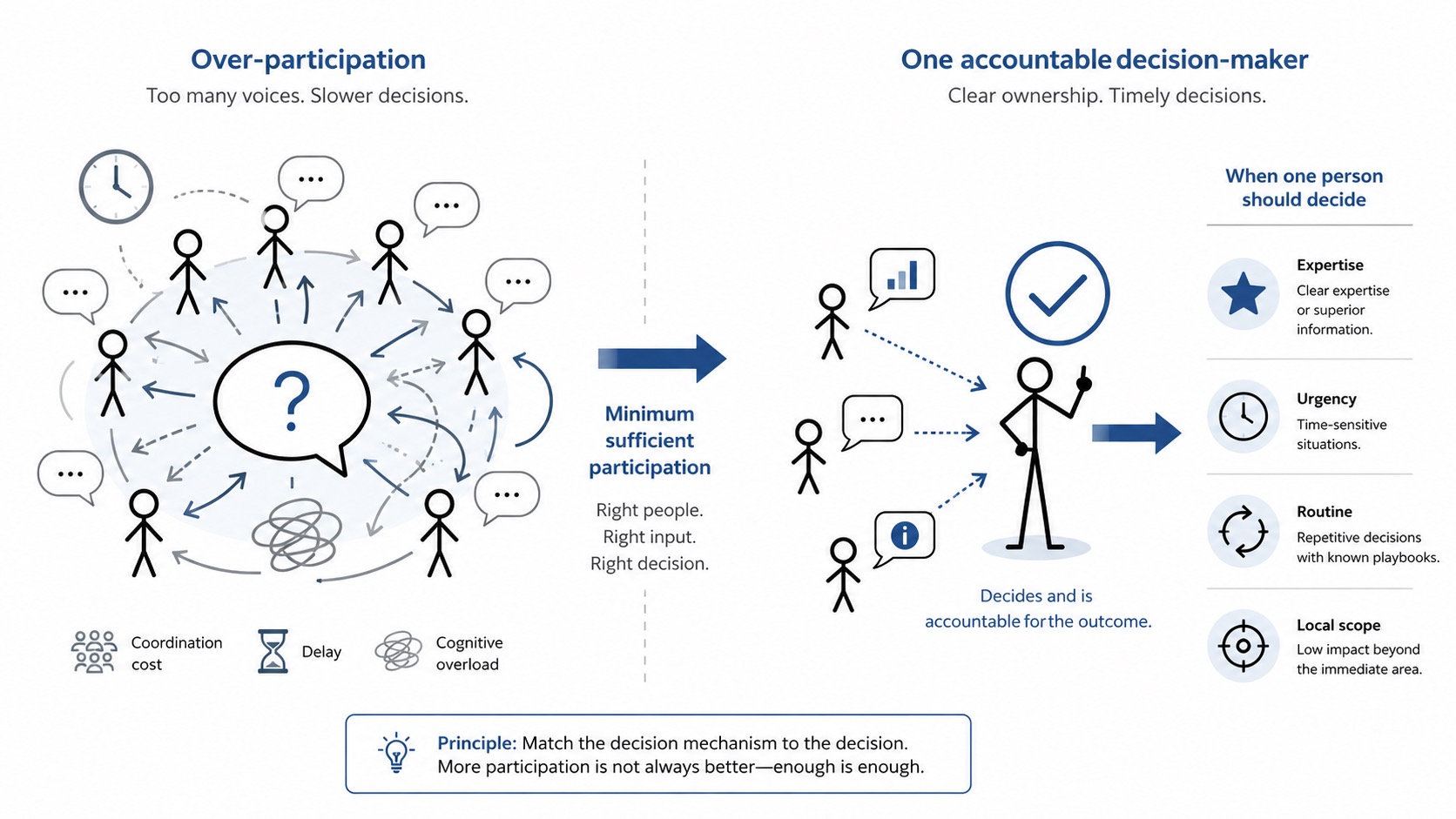
Figure 1. Minimum sufficient participation: matching the decision mechanism to the decision. More participation is not always better — enough is enough.
Executive Summary
Teams are often encouraged to involve more people in decisions. Participation is associated with inclusion, psychological ownership, diverse perspectives, stronger commitment, and protection against unilateral error. These benefits are real. However, the inference that more participation is always better does not follow from the evidence.
Group decision-making is not free. It requires participants to interrupt other work, understand the issue, exchange information, reconcile differences, and establish a collective position. These activities may be justified when they materially improve the quality, legitimacy, or implementation of the decision. They become a source of process loss when the group contributes little information or authority that the decision owner does not already possess.
Research on group performance shows that groups can generate both process gains and process losses. The outcome depends on the task, distribution of information, availability of demonstrably correct solutions, recognition of expertise, motivational conditions, group size, and the procedures used to combine contributions (Kerr & Tindale, 2004). The appropriate question is therefore not whether group decision-making is effective in general. The relevant question is whether group participation adds enough value in a particular decision context to justify its costs.
The literature supports several conditions in which collective decision authority is unlikely to be the best-fit mechanism:
- The decision is routine, structured, or governed by an established rule.
- Relevant expertise is concentrated in a clearly identifiable person.
- The accountable decision owner already possesses sufficient information.
- The consequences are narrow and primarily affect the decision owner’s domain.
- Implementation does not depend on broad acceptance or behavioural change.
- The decision is reversible, experimental, and relatively low-risk.
- Delay costs are high and the decision window is short.
- Existing policy or team agreements have already delegated the authority.
- The group is large relative to the informational value it can add.
- Clear individual accountability is legally, operationally, or ethically required.
These conditions do not necessarily justify secrecy, unilateralism, or disregard for affected people. They justify separating participation in providing information from authority to make the final decision. A leader, specialist, or delegated owner may consult others, seek challenge, disclose reasoning, and remain accountable without transferring final authority to the group.
The paper proposes the term decision-participation overfit to describe excessive participation relative to contextual need. Its possible productivity effects include slower decisions, more meetings, duplicated discussion, cognitive fatigue, diffusion of accountability, repeated reopening of settled matters, and opportunity costs from diverting specialists away from productive work.
To avoid both under-participation and over-participation, organisations should adopt the principle of minimum sufficient participation:
Use the least participative decision mechanism that still provides adequate information, expertise, implementation commitment, legitimacy, cultural integrity, and risk control.
This principle is not a defence of command-and-control management. It is a contingency argument. Some decisions should be individual. Some require advice. Some require consultation with affected parties. Others legitimately require representative participation, majority voting, consent, or consensus. Productivity is influenced not by maximising participation, but by aligning the mechanism to the requirements of the decision.
1. Introduction
1.1 The problem of participation as an unquestioned good
Contemporary organisational practice frequently treats participation as a marker of healthy leadership. Leaders are encouraged to involve teams, distribute authority, increase engagement, and avoid making decisions unilaterally. These practices developed partly in response to legitimate concerns about hierarchy, exclusion, poor information flow, and authoritarian leadership.
However, good intentions can produce poor decision architecture. A team may begin involving everyone in decisions because participation appears fair, psychologically safe, or culturally desirable. Over time, consultation can become compulsory, meetings can multiply, and decisions that once belonged to a clear role can become dependent on broad discussion or informal consensus.
The resulting problem is not collaboration itself. It is the use of collective processes without determining whether the decision context requires them.
Group decision-making can improve outcomes when:
- members hold different pieces of relevant information;
- expertise is genuinely distributed;
- the problem benefits from multiple perspectives;
- collective reasoning can identify a demonstrably better solution;
- implementation depends on widespread commitment;
- multiple groups will bear the consequences;
- legitimacy requires representation or shared authority; or
- the decision concerns collective identity, values, or direction.
Conversely, group decision-making may contribute little when the decision is routine, localised, reversible, time-sensitive, already delegated, or dependent on specialised expertise held by one person.
The practical challenge is therefore to distinguish between necessary participation and participation by habit.
1.2 Purpose of this white paper
This white paper examines when team group decision-making is not relevant or not sufficiently valuable to justify collective authority.
The paper has four aims:
- To clarify the difference between group decision-making, consultation, and individual decision authority.
- To identify evidence-based conditions in which a single accountable decision-maker is likely to be a better contextual fit.
- To explain the productivity risks created by excessive or poorly targeted participation.
- To propose a practical principle for choosing the appropriate breadth of participation.
The intended audience includes team leaders, technology practitioners, agile and delivery professionals, organisational designers, coaches, and researchers concerned with team productivity.
2. Defining the Decision Mechanisms
A central source of confusion is the tendency to treat decision-making as binary: either the leader decides or the group decides. In practice, information input and final authority can be arranged in several ways.
2.1 Individual decision
One identifiable person assesses the issue and makes the decision. The person may be a manager, subject-matter expert, product owner, technical lead, incident commander, or another delegated role.
This does not necessarily mean the decision is arbitrary or unaccountable. The individual may still be required to follow standards, explain the rationale, document assumptions, or submit the decision to review.
2.2 Fact-gathering decision
The decision owner obtains specific facts from other people but does not request their preferred solution. The purpose of participation is information acquisition rather than shared judgement.
For example, a technical lead may ask engineers for system-performance data before selecting a remediation approach.
2.3 Consultative decision
The decision owner invites advice, concerns, alternatives, or challenges from selected participants. The decision owner retains final authority.
Consultation can be extensive without becoming collective decision-making. Participants have voice, but not necessarily equal authority or veto rights.
2.4 Collective decision
The group possesses final decision authority. The decision may be reached through:
- consensus;
- consent;
- majority vote;
- supermajority;
- representative agreement; or
- another collective rule.
Collective decision-making is therefore defined here not merely by the number of people who speak, but by where final authority resides.
3. Group Decision-Making as a Contingent Mechanism
The research literature does not support a universal conclusion that either groups or individuals make better decisions.
Kerr and Tindale’s (2004) review of group performance research found that groups can experience both process gains and process losses. Performance depends on situational and procedural conditions affecting motivation, information processing, and the coordination of members’ resources.
This finding is important because it moves the analysis away from ideological preferences. Group decision-making should not be selected because collective participation is assumed to be inherently superior. Individual decision-making should not be selected because speed or hierarchy is assumed to be inherently superior. The mechanism should be selected according to the requirements of the situation.
The Vroom–Yetton–Jago tradition provides a particularly relevant contingency model. It treats the degree of participation as a decision variable rather than a fixed leadership style. Relevant situational questions include:
- How important is decision quality?
- Does the leader possess sufficient information?
- Is the problem well structured?
- Is acceptance by team members necessary for implementation?
- Would team members accept an individual decision?
- Do participants share the relevant organisational goals?
- Is conflict between participants likely?
- How costly is delay?
The model’s central implication is that highly participative mechanisms are justified in some situations but unnecessary or harmful in others (Vroom & Jago, 2007).
4. The Costs of Collective Decision-Making
4.1 Coordination cost
Every additional participant creates coordination requirements. People must receive background information, understand the issue, prepare contributions, attend discussions, respond to competing arguments, and interpret the final outcome.
The costs are not limited to the duration of a meeting. Participation can involve:
- preparation time;
- context switching;
- asynchronous messages;
- follow-up questions;
- repeated explanation;
- rescheduling;
- emotional labour;
- decision documentation; and
- re-entry into interrupted work.
These costs may be justified when participation improves the decision. They are waste when participants add little unique information, expertise, legitimacy, or implementation value.
4.2 Production blocking
Interactive groups cannot generally express all ideas simultaneously. One person speaks while others wait, modify their contribution, forget a point, or decide not to contribute.
A meta-analysis of brainstorming research found that interacting brainstorming groups tended to produce fewer and lower-quality ideas than equivalent nominal groups in which people generated ideas independently and their outputs were combined. Productivity losses were particularly evident as group size increased (Mullen et al., 1991).
Brainstorming is not identical to decision-making. Nevertheless, this research demonstrates that interaction itself can constrain the use of available cognitive resources. More participants do not automatically produce more usable insight.
4.3 Repetition of shared information
One of the assumed benefits of groups is access to a larger pool of information. However, groups do not reliably use that pool effectively.
Hidden-profile research examines decisions in which different members possess different pieces of information. Lu et al.’s (2012) meta-analysis of 65 studies and 3,189 groups found that groups discussed substantially more commonly held information than unique information. Groups operating under hidden-profile conditions were considerably less likely to identify the optimal solution than groups in which all information was already shared.
This reveals an important paradox:
A group may be assembled because its information is distributed, yet still fail to integrate the distributed information that justified assembling it.
Group discussion can therefore create an appearance of comprehensiveness without producing genuinely broader understanding.
4.4 Failure to use expertise appropriately
Groups do not always give the most weight to the most knowledgeable member. Influence can instead follow confidence, seniority, status, speaking frequency, or social acceptance.
Bonner et al. (2002) found that groups performed more effectively when they were able to recognise and weight the contributions of their strongest members. In their experimental tasks, groups performed approximately at the level of the best corresponding individual when member expertise was identifiable.
This implies that the mere presence of an expert within a group does not guarantee a group-level advantage. The collective process must recognise and use the expertise correctly.
Where expertise is concentrated, identifiable, and directly relevant, the group may add less value than allowing the expert to decide after receiving any necessary contextual input.
4.5 Social loafing and reduced individual contribution
Social loafing refers to the tendency for individuals, under certain conditions, to exert less effort when their contribution is combined with the contributions of others than when their individual performance is identifiable.
Karau and Williams’ (1993) meta-analysis found social loafing across a range of tasks and settings, while also showing that it is moderated by factors such as task importance, identifiability, expectations of others, and group meaning.
This does not mean that all group members deliberately disengage. It means that collective structures can weaken the perceived relationship between individual effort and meaningful outcomes.
In decision-making, this may appear as:
- participants attending but not preparing;
- reliance on others to identify risks;
- superficial agreement;
- reduced challenge;
- abstention from responsibility; or
- acceptance of a result for which no individual feels fully accountable.
4.6 Meeting load and fatigue
Collective decisions often require synchronous meetings. Luong and Rogelberg (2005) found that greater meeting frequency was associated with higher daily fatigue and subjective workload.
The study does not establish that all meetings are harmful. It does show that meetings consume psychological and attentional resources. A team that routinely subjects local or routine decisions to group discussion may create cumulative workload without a corresponding improvement in decision quality.
4.7 Delay cost
Collective decisions require time for availability, discussion, disagreement resolution, and confirmation. Delay may be more costly than a moderately imperfect decision, particularly when:
- an operational incident is continuing;
- a customer is waiting;
- an opportunity is short-lived;
- a dependency is blocking other work;
- a reversible experiment can generate better evidence; or
- the responsible expert already understands the issue.
The relevant productivity measure is therefore not simply whether the group eventually reached a high-quality decision. It is whether the additional quality gained through participation exceeded the value lost through delay.
4.8 Diffusion of accountability
Collective authority can obscure ownership. When many people participate, it may become unclear:
- who is responsible for the result;
- who should monitor implementation;
- who can revise the decision;
- who explains failure;
- who manages emerging risks; or
- whether dissenting members remain committed to execution.
Shared ownership can be appropriate for genuinely collective decisions. However, ambiguous ownership is not the same as shared ownership.
A well-designed individual decision has one accountable owner. A well-designed group decision must still specify who is responsible for implementation, monitoring, communication, and review.
5. Decision-Participation Overfit
5.1 Proposed definition
This paper introduces decision-participation overfit as a proposed conceptual term:
Decision-participation overfit occurs when the breadth, duration, or intensity of participation exceeds what is necessary to produce adequate decision quality, implementation commitment, legitimacy, cultural integrity, and risk control.
The term adapts the logic of contextual fit. A participative mechanism may be valuable in one context and excessive in another.
Overfit can occur through:
- involving too many people;
- giving equal authority to participants with unequal relevance;
- using consensus when consultation would be sufficient;
- reopening decisions already delegated under agreed policy;
- requiring meetings when asynchronous input would suffice;
- involving unaffected people;
- continuing deliberation after material uncertainty has been resolved; or
- treating inclusion in the decision as the only way to provide respect or voice.
5.2 Productivity effects
Decision-participation overfit may reduce productivity through five pathways.
Direct labour cost
The time spent participating is unavailable for other productive work.
Decision latency
The decision is postponed while participation is organised or agreement is sought.
Cognitive and attentional cost
Participants must switch context, hold additional information, and recover concentration after interruption.
Accountability ambiguity
Broad participation can weaken clarity about who owns the judgement and its consequences.
Implementation drag
Excessive deliberation can lead to compromise solutions, unclear rationale, or repeated reconsideration during implementation.
These mechanisms suggest that participation may have diminishing and eventually negative returns. Initial participation can improve information and commitment. Beyond a contextual threshold, additional involvement may add less value than it consumes.
This proposed non-linear relationship should be treated as a conceptual proposition until it is empirically tested.
6. Conditions Under Which the Team Should Not Make the Decision
6.1 The decision is routine or well structured
A structured decision has:
- clear criteria;
- established procedures;
- known constraints;
- limited interpretive ambiguity; and
- a relatively predictable relationship between action and outcome.
Examples include:
- approving an expense within a delegated threshold;
- selecting a standard technical configuration;
- following an incident-response runbook;
- scheduling work within an agreed capacity rule;
- applying an established quality standard; or
- accepting work that meets previously agreed criteria.
When the group has already agreed to the policy, involving the group in every application of that policy creates repeated coordination cost without generating new governance value.
Better-fit mechanism: delegated individual decision within agreed guardrails.
Important caveat: the group should revisit the policy when assumptions change, repeated exceptions emerge, or outcomes indicate that the rule is no longer appropriate.
6.2 Relevant expertise is concentrated in one person
Some decisions depend primarily on specialised knowledge held by one clearly identifiable person. Examples may include:
- a database recovery decision;
- interpretation of a specific regulatory requirement;
- a clinical or safety judgement;
- a security response;
- a specialist architectural choice; or
- a technical diagnosis based on deep system knowledge.
Group participation may still provide context, identify constraints, or challenge assumptions. However, giving equal decision authority to less knowledgeable participants can dilute rather than improve expert judgement.
Better-fit mechanism: expert decides after obtaining necessary contextual input.
Important caveat: expertise should be relevant and demonstrable. Organisational rank, confidence, or tenure should not be treated as automatic evidence of expertise.
6.3 The accountable owner already possesses sufficient information
Participation is less valuable when the decision owner already has the information required to make an adequate decision.
This condition is strongest when:
- relevant data are available;
- uncertainty is low;
- information is not meaningfully distributed;
- there are few hidden dependencies;
- the decision owner has recent direct experience; and
- additional participants are likely to repeat known information.
The decision owner should still ask whether their belief that they possess sufficient information is itself biased. A brief targeted check may be more appropriate than full group deliberation.
Better-fit mechanism: individual decision, possibly preceded by a limited information check.
6.4 The decision has narrow or localised consequences
A decision may primarily affect one role, component, workstream, or domain. When consequences are contained, the people closest to the work are often best positioned to decide.
Examples include:
- choosing how to implement an internally contained task;
- selecting a personal work method;
- adjusting a local workflow;
- resolving a small technical defect;
- prioritising within an already delegated work area; or
- organising a specialist’s own sequence of activity.
Requiring the entire team to decide local matters undermines autonomy and makes the team a bottleneck.
Better-fit mechanism: local owner decides and informs others where necessary.
Important caveat: apparently local decisions can create hidden system effects. The relevant test is consequence scope, not merely organisational location.
6.5 Implementation does not require broad commitment
Participation is often justified because people are more likely to support a decision they helped create. This is particularly important when implementation requires discretionary effort, behavioural change, cooperation across boundaries, or acceptance of personal costs.
However, not every decision requires collective commitment. Some decisions can be implemented through:
- normal role responsibility;
- established operating procedure;
- technical automation;
- contractual obligation;
- routine coordination; or
- direct action by the decision owner.
When acceptance is not a material implementation constraint, transferring authority to the group may not create sufficient benefit.
Better-fit mechanism: owner decides and clearly communicates the rationale and implications.
Important caveat: compliance is not equivalent to commitment. Leaders may underestimate implementation dependence when a decision changes workload, identity, status, professional practice, or relationships.
6.6 The decision is reversible and relatively low-risk
Reversible decisions permit learning through action. In these situations, prolonged deliberation may cost more than making a reasonable choice, observing the results, and adapting.
Examples include:
- trialling a short-term workflow;
- testing a prototype;
- selecting an internal collaboration tool for a limited pilot;
- adjusting a meeting format;
- experimenting with a minor feature; or
- choosing between options with similar downside exposure.
This logic is particularly relevant in technology and product development, where experiments can generate better information than abstract debate.
Better-fit mechanism: delegated owner decides, defines the experiment, and establishes a review point.
Important caveat: reversibility should be assessed realistically. Technical rollback may be easy while reputational, relational, privacy, or cultural harm remains difficult to reverse.
6.7 The cost of delay is high
Urgent decisions often require narrower participation. Examples include:
- active operational incidents;
- safety threats;
- cybersecurity events;
- immediate customer harm;
- expiring commercial opportunities; or
- time-critical regulatory responses.
In these contexts, a predetermined decision owner should act within established authority and later account for the decision.
Better-fit mechanism: qualified individual decides under emergency or time-critical protocols.
Important caveat: urgency can be manufactured or exaggerated to suppress legitimate participation. Organisations should define urgency criteria before a crisis and conduct retrospective review afterwards.
6.8 The decision has already been delegated
Teams frequently waste time by informally reclaiming decisions that have already been delegated to a role.
For example, a team may agree that:
- the product owner controls backlog ordering;
- the technical lead owns implementation architecture within defined constraints;
- the incident commander directs the active response;
- the facilitator selects the workshop process;
- the designer determines detailed interaction treatments; or
- the budget holder approves expenditure below a threshold.
If every delegated choice must still return to the team for collective validation, the authority is nominal rather than real.
Better-fit mechanism: delegated owner decides and remains accountable within agreed boundaries.
Important caveat: delegation must be explicit, legitimate, understood, and revocable. It should not be used to avoid scrutiny or affected-party voice.
6.9 Participation cost exceeds likely informational value
The relevance of a participant should not be determined simply by team membership.
Participation is less justified where a person:
- has no relevant information;
- lacks applicable expertise;
- is not materially affected;
- has no implementation role;
- carries no decision accountability; and
- adds no required legitimacy or representation.
Inviting everyone may feel inclusive, but it can consume the attention of people whose work is unrelated to the issue.
Better-fit mechanism: involve only the minimum set of relevant information holders, affected parties, experts, and accountable owners.
Important caveat: relevance must not be defined solely through formal authority. People with less organisational power may hold critical experiential or contextual knowledge that senior decision-makers cannot see.
6.10 Clear individual accountability is required
Certain decisions require an identifiable accountable person because of:
- legal obligations;
- professional standards;
- safety responsibilities;
- fiduciary duty;
- regulatory accountability;
- delegated financial authority; or
- operational command structures.
A group may advise, review, or challenge, but collective discussion does not remove the named individual’s accountability.
Better-fit mechanism: accountable role-holder decides after completing required consultation or assurance.
Important caveat: named accountability should not be confused with unchecked discretion. Appropriate review, evidence, and escalation controls remain necessary.
7. A Practical Decision Test
Before selecting a collective mechanism, a team should answer the following questions.
| Contextual question | When the answer is “yes” | Implication |
|---|---|---|
| Is critical information distributed across several people? | Collective input may materially improve quality | Gather information or consult |
| Is relevant expertise distributed rather than concentrated? | Multiple judgements may be necessary | Consult or use a small expert group |
| Does implementation require discretionary commitment from several people? | Participation may strengthen ownership | Consult or share authority |
| Are several groups materially affected by the consequences? | Representation and legitimacy become important | Include affected parties |
| Is the decision difficult or impossible to reverse? | More challenge and assurance may be justified | Use broader review |
| Does the decision concern collective purpose, identity, ethics, or values? | Technical authority alone may be insufficient | Use representative or collective deliberation |
| Is conflict likely to obstruct implementation? | Structured participation may surface and resolve disagreement | Use facilitated consultation or collective decision |
| Can a group identify a demonstrably better solution? | Collective reasoning may outperform an individual | Use a small capable group |
| Does one person already hold sufficient information and legitimate authority? | Collective authority may add little | Individual decides |
| Is the decision routine, reversible, localised, or time-critical? | Delay and coordination costs may dominate | Delegate to one owner |
The questions should not be treated as a mechanical scoring system. They are diagnostic prompts for identifying what participation is expected to contribute.
8. Minimum Sufficient Participation
8.1 Definition
This paper proposes minimum sufficient participation as a decision-design principle:
Use the least participative mechanism that still provides adequate decision quality, implementation commitment, legitimacy, cultural integrity, and risk control.
The principle contains two deliberate constraints.
First, minimum means that participation should not be expanded without a clear reason. Every participant and every additional layer of authority should contribute identifiable value.
Second, sufficient means that efficiency cannot justify excluding necessary expertise, affected communities, legitimate stakeholders, or people whose commitment is essential.
The objective is neither maximum speed nor maximum participation. It is contextual adequacy.
8.2 A participation ladder
Level 1: Decide
One accountable person decides using available information.
Use when the decision is structured, localised, low-risk, reversible, and within clear authority.
Level 2: Gather information, then decide
The owner requests specific facts or data from selected people.
Use when information is distributed but authority and judgement remain appropriately concentrated.
Level 3: Seek advice, then decide
The owner asks selected participants for recommendations, alternatives, concerns, or challenge.
Use when judgement benefits from multiple perspectives but final accountability should remain individual.
Level 4: Consult affected parties, then decide
The owner explicitly includes people who will experience or implement the consequences.
Use when legitimacy, relational impact, or implementation commitment matters, but collective final authority is not required.
Level 5: Representative group decides
A deliberately constituted group holds final authority.
Use when interests, expertise, impacts, or accountabilities are distributed across several constituencies.
Level 6: Full group decision
The entire relevant group decides using consensus, consent, or voting.
Use when the decision concerns genuinely shared purpose, norms, identity, mutual obligations, or consequences that the whole group must collectively own.
The ladder should not be interpreted as a hierarchy in which Level 6 is more mature than Level 1. Each level is appropriate under different conditions.
9. When Group Decision-Making Remains Necessary
An argument against excessive group decision-making can itself be overextended. Individual authority is not automatically efficient, accurate, or legitimate.
9.1 Complex intellective problems
Groups can outperform individuals when tasks have demonstrably correct solutions and members can communicate and evaluate valid reasoning.
Laughlin et al. (2006) found that groups of three, four, or five participants outperformed the best equivalent individual on complex letters-to-numbers problems. The study shows that groups can generate genuine process gains when reasoning can be demonstrated and adopted.
However, the result does not apply automatically to all organisational decisions. Many organisational problems are judgemental, politically contested, value-laden, or affected by incomplete feedback.
9.2 Distributed unique information
A meta-analysis by Mesmer-Magnus and DeChurch (2009), covering 72 independent studies, found that effective information sharing was positively related to team performance, cohesion, decision satisfaction, and knowledge integration.
Where relevant information is dispersed, excluding team members may produce an underinformed decision. The appropriate response may be structured information gathering, consultation, or collective deliberation depending on whether information input alone is sufficient.
9.3 Commitment and satisfaction
Participative decision-making can strengthen satisfaction, ownership, and willingness to implement decisions. Miller and Monge’s (1986) meta-analysis found evidence supporting affective benefits of participation, particularly employee satisfaction, while productivity effects varied by research setting and other conditions.
Where a decision requires sustained discretionary effort, participation may be productive even when one leader could technically make the decision alone.
9.4 Legitimacy and ethical standing
Some people must participate not because they possess superior technical information, but because they have legitimate standing in relation to the consequences.
This includes decisions affecting:
- communities;
- identity;
- employment conditions;
- access to resources;
- cultural values;
- personal data;
- public interests; or
- unequal distributions of risk and benefit.
A technically efficient decision may still be ethically deficient if those carrying the consequences have no meaningful voice.
10. Cultural and Decolonising Considerations
The distinction between consultation and collective authority should not be used to reproduce hierarchical or colonial decision norms.
Western managerial literature often privileges speed, measurable output, role authority, and individual accountability. These criteria can obscure relational responsibility, collective wellbeing, historical power imbalances, and the standing of communities whose knowledge is not recognised as formal expertise.
Tuhiwai Smith (2021) argues that research and knowledge practices must be examined for the power assumptions they reproduce. Applied to organisational decision-making, this requires questioning:
- who defines expertise;
- whose knowledge is treated as evidence;
- who is considered affected;
- who sets the productivity measure;
- who receives the benefits;
- who carries the risks; and
- who has authority to determine whether consultation was sufficient.
A minimum-sufficient-participation principle must therefore contain safeguards. “Minimum” cannot mean excluding marginalised people because their knowledge is inconvenient, qualitative, community-based, or inconsistent with dominant organisational assumptions.
Similarly, collective cultural traditions should not be reduced to a requirement that every decision be made through full consensus. Consultation, relational accountability, delegated stewardship, and collective review can coexist with individual decision authority.
For example, the principle of shura, or consultative deliberation, distinguishes the ethical duty to seek relevant counsel from the procedural claim that every participant must possess equal final authority. The appropriate arrangement depends on the matter, the responsibilities of the decision-maker, the standing of those affected, and the wider system of accountability.
In an Aotearoa New Zealand context, decision efficiency should not be assessed only through elapsed time. Effects on mana, trust, relationships, community legitimacy, and future willingness to collaborate are also productivity consequences, even when they are harder to quantify.
11. Implications for Technology-Driven Organisations
Technology teams are particularly vulnerable to decision-participation overfit because contemporary delivery methods emphasise:
- autonomous teams;
- collaborative workshops;
- cross-functional participation;
- agile ceremonies;
- consensus-building;
- transparency; and
- distributed ownership.
These practices can improve coordination and reduce unilateral error. However, they may also create ambiguity over which decisions genuinely belong to the group.
11.1 Product decisions
A product direction affecting customers, funding, strategy, and delivery dependencies may require broad input. A minor backlog-ordering decision within agreed strategy may belong to the product owner.
11.2 Technical decisions
A major architectural decision with long-term system consequences may require several specialist perspectives. A local implementation detail within established architectural constraints may belong to the engineer doing the work.
11.3 Incident decisions
An active incident generally requires clear command authority. Multiple specialists provide information, but one incident commander coordinates the response and makes time-critical decisions.
11.4 Delivery decisions
A team may collectively agree its operating policies, capacity assumptions, and risk tolerances. Once agreed, routine allocation decisions should not necessarily require renewed consensus.
11.5 People decisions
Decisions affecting employment, performance, wellbeing, or professional development require appropriate confidentiality, expertise, and procedural fairness. Full-team participation may be inappropriate even where transparency is generally valued.
The broader principle is that autonomy requires boundaries. A team cannot operate autonomously if every local choice requires universal participation.
12. Emerging Technology and Participation Inflation
Digital collaboration tools reduce the practical cost of inviting people into a decision. Messaging platforms, online whiteboards, polling tools, video meetings, and AI summarisation make broad participation easier.
This creates both an opportunity and a risk.
12.1 Opportunities
Technology can support minimum sufficient participation by:
- collecting asynchronous input;
- identifying participants with relevant expertise;
- summarising distinct arguments;
- exposing unresolved assumptions;
- recording dissent;
- documenting the decision rationale;
- tracking who is accountable;
- prompting review dates; and
- comparing predicted and actual outcomes.
AI systems could help a decision owner detect whether important stakeholder categories or perspectives are absent.
12.2 Risks
Technology can also produce participation inflation: the expansion of participation simply because adding people is easy.
Examples include:
- copying an entire team into a discussion;
- opening every decision to comment;
- treating message reactions as consent;
- generating large quantities of repetitive input;
- using AI summaries that conceal minority concerns;
- confusing visibility with meaningful voice; or
- inviting consultation after the decision is effectively complete.
AI can compress contributions, but it does not determine whose knowledge has legitimate standing. It may also reinforce dominant viewpoints where those viewpoints appear more frequently in the input.
Decision-support technology should therefore help answer two separate questions:
- Whose information or perspective is materially required?
- Who legitimately holds final authority?
The tool should not assume that the widest possible participation is the safest or most inclusive arrangement.
13. Proposed Evaluation Model
The value of a decision mechanism can be conceptualised as follows:
Net decision contribution =
decision quality
- implementation commitment
- legitimacy
- learning value
- relationship value
minus
participation cost
- delay cost
- attention and interruption cost
- process loss
- accountability ambiguity
- implementation rework
This is a conceptual model rather than a validated measurement instrument. Its purpose is to make costs and benefits visible.
A collective mechanism is warranted where its additional benefits exceed its additional costs. An individual mechanism is warranted where adequate quality, legitimacy, commitment, and control can be achieved without transferring final authority to the group.
14. Limitations of the Evidence
Several limitations should constrain the conclusions of this paper.
First, substantial group-decision research has been conducted using laboratory tasks. Logic problems, brainstorming activities, and hidden-profile exercises do not fully represent organisational environments involving hierarchy, culture, identity, power, history, or long-term relationships.
Second, productivity is measured inconsistently. Studies may use decision accuracy, number of ideas, completion time, employee satisfaction, fatigue, or perceived performance. These measures are related but not interchangeable.
Third, an individual decision may appear efficient because downstream costs are not immediately measured. Resistance, mistrust, rework, silence, and reduced psychological ownership may emerge later.
Fourth, teams may incorrectly conclude that information or expertise is concentrated. People in positions of authority can be unaware of knowledge held by frontline employees, cultural communities, customers, or less powerful team members.
Fifth, the proposed concepts of decision-participation overfit and minimum sufficient participation require empirical evaluation. They synthesise existing findings but have not yet been established as validated constructs.
The conclusions should therefore be applied as contextual propositions rather than fixed rules.
15. Conclusion
Group decision-making is an organisational mechanism, not an intrinsic virtue.
It can improve decisions where information, expertise, consequences, commitment, legitimacy, or ownership are genuinely distributed. It can also reduce productivity where the problem is structured, the authority is already delegated, expertise is concentrated, consequences are localised, implementation does not require broad commitment, or the costs of participation and delay exceed the likely improvement in quality.
The central distinction is between having a voice and holding final authority. Teams can provide information, advice, challenge, and cultural or stakeholder insight without collectively making every decision.
The appropriate question is not:
How can everyone be included in this decision?
It is:
What form and degree of participation are necessary for this decision to be sufficiently informed, legitimate, implementable, culturally responsible, and accountable?
The principle of minimum sufficient participation provides a pragmatic response:
Use the least participative mechanism that still satisfies the genuine requirements of the context.
This principle avoids two symmetrical failures. Too little participation can produce ignorance, illegitimacy, exclusion, and resistance. Too much participation can produce delay, fatigue, diluted expertise, unclear accountability, and coordination waste.
Team productivity is therefore unlikely to be maximised by consistently choosing either individual or collective authority. It is more likely to improve when decision rights, participation, and context are deliberately aligned.
Summary of Key Outtakes
- Group decision-making produces benefits and costs; neither is universal.
- Participation should be justified by identifiable informational, implementation, legitimacy, relational, or learning needs.
- Consultation and collective authority are different mechanisms.
- Individual decisions are generally better suited to routine, localised, reversible, urgent, delegated, and expertise-dependent matters.
- Excess participation can create process loss, decision delay, fatigue, accountability ambiguity, and opportunity cost.
- Distributed information does not automatically require distributed final authority.
- The appropriate principle is minimum sufficient participation, not minimum participation.
- Broader participation remains necessary where consequences, values, legitimacy, knowledge, or implementation responsibility are genuinely shared.
- Efficiency must not be used to exclude Indigenous, minority, frontline, or community knowledge.
- Decision-mechanism fit should be evaluated through both immediate decision performance and downstream implementation effects.
References
Bang, D., & Frith, C. D. (2017). Making better decisions in groups. Royal Society Open Science, 4(8), Article 170193. doi:10.1098/rsos.170193
Bonner, B. L., Baumann, M. R., & Dalal, R. S. (2002). The effects of member expertise on group decision-making and performance. Organizational Behavior and Human Decision Processes, 88(2), 719–736. doi:10.1016/S0749-5978(02)00010-9
Karau, S. J., & Williams, K. D. (1993). Social loafing: A meta-analytic review and theoretical integration. Journal of Personality and Social Psychology, 65(4), 681–706. doi:10.1037/0022-3514.65.4.681
Kerr, N. L., & Tindale, R. S. (2004). Group performance and decision making. Annual Review of Psychology, 55, 623–655. doi:10.1146/annurev.psych.55.090902.142009
Laughlin, P. R., Hatch, E. C., Silver, J. S., & Boh, L. (2006). Groups perform better than the best individuals on letters-to-numbers problems: Effects of group size. Journal of Personality and Social Psychology, 90(4), 644–651. doi:10.1037/0022-3514.90.4.644
Lu, L., Yuan, Y. C., & McLeod, P. L. (2012). Twenty-five years of hidden profiles in group decision making: A meta-analysis. Personality and Social Psychology Review, 16(1), 54–75. doi:10.1177/1088868311417243
Luong, A., & Rogelberg, S. G. (2005). Meetings and more meetings: The relationship between meeting load and the daily well-being of employees. Group Dynamics: Theory, Research, and Practice, 9(1), 58–67. doi:10.1037/1089-2699.9.1.58
Mesmer-Magnus, J. R., & DeChurch, L. A. (2009). Information sharing and team performance: A meta-analysis. Journal of Applied Psychology, 94(2), 535–546. doi:10.1037/a0013773
Miller, K. I., & Monge, P. R. (1986). Participation, satisfaction, and productivity: A meta-analytic review. Academy of Management Journal, 29(4), 727–753. doi:10.2307/255942
Mullen, B., Johnson, C., & Salas, E. (1991). Productivity loss in brainstorming groups: A meta-analytic integration. Basic and Applied Social Psychology, 12(1), 3–23. doi:10.1207/s15324834basp1201_1
Tuhiwai Smith, L. (2021). Decolonizing methodologies: Research and Indigenous peoples (3rd ed.). Bloomsbury Academic.
Vroom, V. H., & Jago, A. G. (2007). The role of the situation in leadership. American Psychologist, 62(1), 17–24. doi:10.1037/0003-066X.62.1.17
Author’s Conceptual Note
The terms decision-participation overfit, participation inflation, and minimum sufficient participation, together with the proposed net-decision-contribution model, are conceptual syntheses developed for this research. They are informed by the cited literature but should not be presented as previously validated academic constructs.
References
References will be added as evidence review progresses. Every citation will follow APA 7 and appear in the Research Library.
Related research
Suggested citation
Version history
- v1.0June 2026Initial publication of the white paper, now integrated into the Decision Compass Research Series as Paper 001.
About the author
Ammar Sagban is a practitioner-researcher developing the Decision Compass Institute — an independent research initiative focused on intentional teaming, group decision-making and the design of team systems.